
Ever get a text that says “we should do smth this weekend” and wonder what’s behind it? Relax. Smth meaning in text is simple: it stands for “something.” That’s the whole story.
Still, a four-letter shortcut can cause real confusion. People mix it up with SMH. Others read secret drama into a harmless message. A few use it in the wrong place at the wrong time.
This guide clears it all up. You’ll get the smth definition, real examples, comparison tables, reply ideas, and clear rules for work and play. Grab a coffee. It’s a quick, friendly read.
Smth Meaning in Text at a Glance
| Question | Quick answer |
|---|---|
| What does smth stand for? | Something |
| Is it internet slang? | Yes, it’s an informal abbreviation |
| Does it have a hidden meaning? | No |
| Is it the same as SMH? | No. SMH means “shaking my head” |
| Is it the same as sth? | Same meaning, different habitat |
| Safe for formal emails? | No. Write the full word |
What Does “Smth” Mean in Text?
Here’s the short version. Smth means “something.” Nothing more, nothing less.
The Simple Smth Definition
People type smth in texting when they want to move fast. Wiktionary lists smth as an abbreviation of “something.” YourDictionary tags it as internet slang.
You’ll spot it in text messages, comments, captions, and DMs. Here are three quick examples:
- “I need smth to eat.”
- “Wanna do smth tonight?”
- “Did you say smth?”
Swap in “something” every time. The sentence still works. That’s the easiest test for any smth abbreviation.
How Smth Builds Itself From Something
Ever wonder how the shortening works? The word loses its vowels and its tail. What’s left is a tight skeleton of consonants.
| Feature | Something | Smth |
|---|---|---|
| Letters | 9 | 4 |
| Letters kept | All | s, m, t, h |
| Letters dropped | None | o, e, i, n, g |
| Keystrokes saved | 0 | 5 |
| Length reduction | 0% | About 56% |
That’s a big cut for such a small word. It’s the same logic behind other shortened words in texting slang.
What Dictionaries Say About the Smth Abbreviation
Dictionaries treat smth as a casual shortcut. It isn’t a standalone word. Wiktionary even backs its entry with a September 2024 Cosmopolitan article, which shows that mainstream media has used it too.
The older cousin, sth, has wider recognition. OneLook lists sth entries in Collins, Cambridge, Wordnik, Dictionary.com, and several other references. Cambridge keeps it simple. It calls sth a “written abbreviation for something.”
So the something meaning never changes. Only the spelling habit does.
Why People Write “Smth” Instead of “Something”
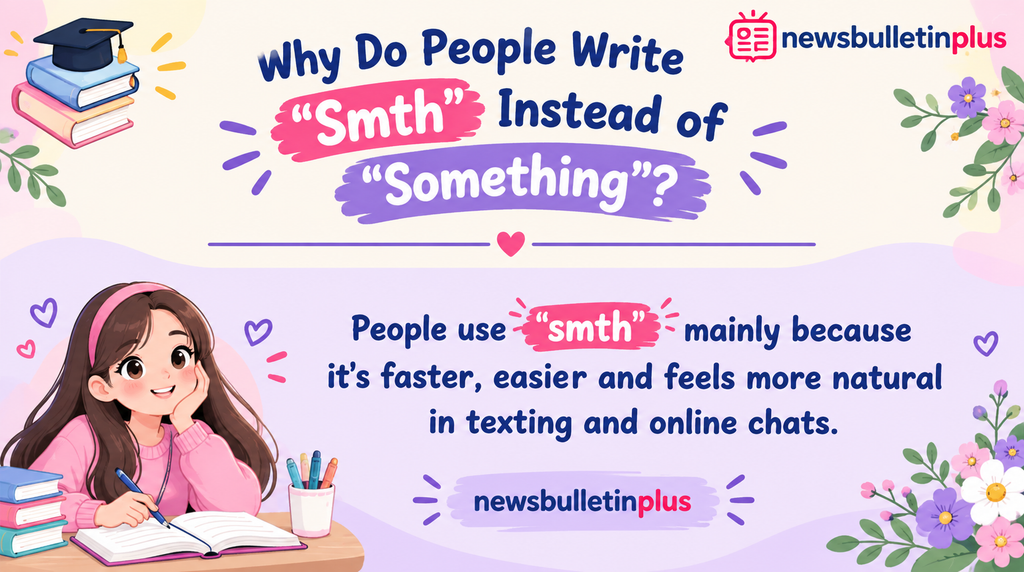
Three forces drive it. Speed comes first. Tone comes second. Habit wraps things up.
Speed and Fewer Keystrokes
Typing on a phone takes effort. Thumbs slip. Autocorrect interferes. Cutting five letters from a word you use all day adds up fast.
Think about a busy group chat. You might write “something” a dozen times in an hour. That’s 60 saved keystrokes if you switch to smth. Small savings pile up.
A Relaxed Tone in Casual Text Messages
Full words can feel stiff in casual text messages. Compare these two:
- “I have something to tell you.”
- “I have smth to tell you.”
The second one sounds like a friend. It’s looser and lighter. That’s why casual texting loves it.
Where Did Smth Come From?
Nobody has documented its first use. No dictionary lists a birth date. Any article that names an exact year is guessing.
We do know the wider story. Early phones capped standard text messages at 160 characters. That limit pushed people toward texting shortcuts of every kind. Yet no source ties smth to that limit specifically.
SMH offers a useful contrast. Merriam-Webster says SMH has appeared since at least the early 1990s and cites a July 1994 Usenet post. That’s about 32 years of documented use by 2026. Smth has no such paper trail.
How Context Changes the Smth Meaning
Here’s the key idea. Smth never changes. The words around it do.
“Something” is a vague word by nature. It points at anything. So smth inherits that vagueness. Your reading of the tone comes from the sentence, the sender, and your history together.
Smth in Real Sentences
| Message | Plain meaning | Tone you might read |
|---|---|---|
| “Smth’s bothering me” | Something is bothering me | Serious |
| “Let’s do smth fun” | Let’s do something fun | Upbeat |
| “You said smth?” | Did you say something? | Neutral |
| “I have smth to tell you” | I have something to tell you | Curious or nervous |
| “Grab me smth from the store” | Bring me an item | Practical |
| “Say smth!” | Speak up | Impatient |
Notice something? The abbreviation stays put. The mood shifts every time.
When Smth Sounds Serious, Playful, or Vague
Some competitor articles list “hinting at trouble” or “suggesting an idea” as separate meanings. That’s misleading. Those are just everyday communication habits.
People use vague words for many reasons:
- They want to build curiosity.
- They haven’t decided what to say yet.
- They don’t want to type a long explanation.
- They’re testing whether you’ll ask.
The fix is easy. When a message feels loaded, ask a direct question. “Smth like what?” solves it in four words.
Smth vs. Sth vs. SMH: Clearing Up the Confusion
These three trip people up the most. Let’s sort them out.
Smth vs. Sth
Both mean “something.” The difference lies in where you meet them.
| Term | Meaning | Typical home |
|---|---|---|
| smth | Something | Casual chats, social apps, texts |
| sth | Something | Dictionaries, grammar notes, learner materials |
Sth shows up in usage examples like “have something against sth.” Wiktionary defines it as an abbreviation of something. English learners often see it in class before they ever see smth in a text.
Some native speakers rarely meet sth at all. One language forum poster admitted never seeing it. Another replied that “No native speaker is going to have any trouble guessing their meaning.” That’s a fair summary. Either version gets the job done.
Smth vs. SMH
Now the big one. SMH is not smth.
| Term | Stands for | Feeling it carries |
|---|---|---|
| smth | Something | Neutral |
| SMH | Shaking my head | Disapproval or disbelief |
| SMDH | Shaking my damn head | Stronger frustration |
| SMFH | Shaking my f-ing head | Strong frustration |
Merriam-Webster describes SMH as “an expression of disapproval or disbelief.” Dictionary.com adds that the same letters can occasionally mean “so much hate” or “scratching my head.”
Here’s how to keep them apart:
- Smth has a “t” and sits inside a sentence.
- SMH has no “t” and works as a standalone reaction.
Compare “I need smth” with “He forgot again. SMH.” One asks for an item. The other sighs.
Other Texting Abbreviations Worth Knowing
Smth sits in a big family of text abbreviations. Here are a few that Merriam-Webster and other references confirm:
| Abbreviation | Meaning |
|---|---|
| lol | Laugh out loud |
| brb | Be right back |
| FWIW | For what it’s worth |
| SMH | Shaking my head |
| sth | Something |
Learning a handful of texting abbreviations makes online chats far less puzzling.
Capital STH: Same Letters, Different Worlds
Fun fact time. Capital letters change everything. Wikipedia’s STH page lists a human gene, soil-transmitted helminths (parasitic worms), season ticket holders, and a Saint Helena country code.
Please don’t text your friend about worms by accident. Context saves the day again. Similarly, SMH can refer to The Sydney Morning Herald in Australia.
Where People Use Smth: Social Media, Dating Apps, and Gaming Chats
Smth appears anywhere people type fast and casually. Still, each space has its own flavor. One note first: no platform publishes word-level usage counts. Treat any percentage you see online with suspicion.
Smth on Social Media
Social media rewards short, punchy writing. Captions and comments fly by. Online posts get skimmed in seconds.
On Instagram you might see “posting smth soon” under a story. On Snapchat a quick “sending you smth” fits the rapid back-and-forth. These social platforms favor chat slang because nobody wants to read an essay in a comment thread.
Smth works well in:
- Captions
- Story replies
- Comment threads
- Quick DMs
It works less well in a brand announcement or a customer reply. Save the full word for those.
Smth on Dating Apps
Dating apps create a unique tension. People want to sound relaxed. They also want to sound clear.
Smth shows up in dating messages like “wanna grab smth to drink?” That’s perfectly natural. It reads as easygoing and low pressure in dating chats.
Dating bios are trickier. A line like “looking for smth real” sounds vague. Matches can’t tell what you actually want. A specific line works better: “Looking for a serious relationship. Big on hiking and Sunday brunch.”
Here’s a quick guide for online dating on any of the major dating platforms:
| Where | Smth okay? | Better move |
|---|---|---|
| First message | Yes, if casual | Add a clear question |
| Ongoing chat | Yes | Keep it light |
| Bio | Rarely | Say the specific thing |
| Serious talk | Skip it | Use full words |
Smth in Gaming Chats
Gaming chats move at lightning speed. During online gaming, a second can decide a match. Nobody types full words when an enemy pushes the objective.
So gamer chat overflows with digital shortcuts. A teammate might type “smth’s coming left.” Everyone understands. The character limit isn’t the reason. Discord allows 2,000 characters per message, or 4,000 with Nitro. Speed is the reason.
Here’s a smart tip for game chats. Vague words waste time in a fight. “Enemy left!” beats “smth’s left” every time. Use smth for banter. Use precise callouts for tactics.
You’ll see it across gaming communities in:
- Lobby chatter
- Post-match talk
- Stream chat
- Clan messages
Casual gaming messages tolerate all of it.
Smth in Casual Conversations With Friends
This is smth’s home turf. Casual conversations with friends need no polish. Friendly chats thrive on shortcuts.
Interestingly, smth stays on the screen. People rarely spell the letters out loud. They say the full word. That split matters. It reminds you that smth belongs to informal conversations in writing. It’s a digital slang habit, not a spoken language habit.
Smth in Professional Communication
Now for the serious side. Professional communication follows different rules.
Workplace Chats vs. Formal Emails
Some teams chat casually on Slack or Teams. In those workplace chats, smth might pass without a raised eyebrow. Culture matters. If your manager writes in abbreviations, you can too.
Formal emails are another story. Professional emails and business emails call for the full word. Smth can look careless there. It also risks confusion. Readers may not know the term.
Consider this simple scale:
| Setting | Smth fits? |
|---|---|
| Friends’ group chat | Yes |
| Casual team chat | Maybe |
| Message to your manager | Use the full word |
| Client email | No |
| Job application | No |
| Legal or HR message | No |
Rewrite Guide for Work Communication
Vague words weaken business communication. Replace them with specifics. Here’s how:
| Casual version | Professional version |
|---|---|
| “Need smth from you by 3” | “Please send the Q3 report by 3 p.m.” |
| “Let’s fix smth in the deck” | “Let’s revise slide 4 of the deck.” |
| “Smth came up” | “A scheduling conflict came up.” |
| “I heard smth about the launch” | “I heard the launch date may move.” |
Notice the pattern. The professional versions name the thing. That’s better formal communication and better workplace emails. It also cuts follow-up questions.
Good email communication respects your reader’s time. Clear beats cute. The same rule applies to professional messages of every kind and to formal writing in general.
When to Avoid Smth
Smth is harmless. Yet some moments call for full words.
Cross-Cultural Chats
Cross-cultural chats raise special challenges. International conversations include people who learned English in school. They may know sth from textbooks but never see smth.
Slang travels poorly. Language differences make shortcuts riskier. A translation tool may stumble on online slang it doesn’t recognize. That’s true of most internet abbreviations.
Keep these tips in mind for intercultural communication:
- Write full words with new contacts.
- Skip slang in international messaging until you know the other person.
- Explain an abbreviation once if it confuses someone.
- Match the other person’s style.
Clear writing builds trust in global chats. Fancy shortcuts don’t.
Sensitive Situations
Serious topics deserve full sentences. Think of condolences, apologies, health news, or conflict. “I need to tell you smth” can spike anxiety. Say what you mean instead.
Avoid smth when:
- You share bad news.
- You apologize.
- You address a conflict.
- You write to someone older who dislikes slang.
- You send anything official.
Warmth comes from clarity. Abbreviations can feel cold in tender moments.
How to Reply to a Message With Smth
The reply strategy is simple. Smth is vague, so ask a follow-up question. Here are ready-to-use options.
| Tone | Sample reply |
|---|---|
| Casual | “Like what?” |
| Curious | “Smth good or smth bad?” |
| Funny | “Smth? Could you be any more mysterious?” |
| Neutral | “Sure. What did you have in mind?” |
| Supportive | “I’m here. Tell me more.” |
| Professional | “Could you share more detail?” |
A few extra tips help:
- Match the sender’s energy.
- Don’t over-read the message.
- If the sender seems upset, ask directly.
- Use a call when a text feels too vague.
Sometimes a quick voice chat clears everything in ten seconds. It beats ten minutes of guessing in virtual chats.
Mini Case Studies: Smth in Action
These four scenarios are illustrative. They aren’t real people or studies. They show common patterns in digital conversations and internet communication.
Case Study: The Group Chat Mix-Up
Maya texts her roommates: “Need smth from the store. Anyone going?” Jordan skims it and replies, “why are you shaking your head lol?” He read smth as SMH.
Maya clears it up fast. “Smth means something!” Everyone laughs.
Lesson: Similar letters cause fast misreads. When a message seems oddly negative, reread it slowly.
Case Study: The Vague Dating Bio
Alex writes “looking for smth real” on a profile. Matches keep asking, “Like what?” Alex feels frustrated.
Alex rewrites it: “Looking for a serious relationship. Love hiking and cooking.” The conversations improve right away.
Lesson: Vague words invite vague responses. Specific bios attract specific matches.
Case Study: The Workplace Message
Priya messages her manager: “Need smth from finance by 3.” The manager replies with three questions. Priya loses ten minutes.
She tries again next time: “Please ask finance for the invoice totals by 3 p.m.” No follow-ups appear.
Lesson: In work communication, precision saves time. Smth costs more than it saves.
Case Study: The Language Learner
Lin studies English abroad. Her textbook uses “sth” in grammar notes. A friend then texts “wanna do smth?” Lin pauses.
She checks a dictionary and finds smth means the same thing. She adds the shortcut to her notes.
Lesson: Sth and smth share one meaning. Learners just meet them in different places.
Common Misunderstandings About Smth
Let’s bust a few myths. Some pages online make wild claims. Here’s what’s actually true.
Myth: Smth means someone is hiding something. Fact: It only means “something.” Tone comes from context.
Myth: Smth is the same as SMH. Fact: They differ in meaning and use. Smth is a noun replacement. SMH is a reaction.
Myth: Smth is flirty. Fact: The abbreviation has no romantic tone. Only the surrounding message can flirt.
Myth: Smth is rude. Fact: It’s neutral. Rudeness comes from wording, not the shortcut.
Myth: Everyone under 25 uses it. Fact: No reliable data supports an age claim. Habits vary by person and group.
Myth: Smth has secret alternate meanings. Fact: Some low-quality pages claim it can mean “smooth.” The dictionaries checked for this article list only “something.”
A simple rule protects you. Trust dictionaries over clickbait.
Quick Smth Cheat Sheet
Keep this list handy:
- Smth = something.
- Use it in casual chats and informal messages.
- Skip it in formal writing and formal emails.
- Sth means the same thing but appears in dictionaries.
- SMH means “shaking my head.”
- Ask a follow-up when a message feels vague.
- Use full words for serious topics.
- Choose full words in cross-cultural chats.
Conclusion: Smth Meaning in Text, Explained
Smth is a tiny shortcut with a simple job. It replaces “something” so you can type faster. That’s it. The smth meaning never hides a code.
Context sets the tone. A friend’s “let’s do smth fun” feels warm. A boss’s “need smth from you” feels vague. Your best move in both cases is to read the whole message and ask if you’re unsure.
Use it freely in casual texting. Skip it in professional messages. When in doubt, spell it out. After all, five extra letters cost almost nothing.
FAQs About Smth Meaning in Text
What does smth mean in texting?
It’s short for “something.”
Is smth a real word?
It’s an informal abbreviation, not a standalone word.
Why do people use smth instead of something?
It saves typing time and sounds relaxed.
Is smth the same as sth?
Yes, both mean “something,” but sth appears mostly in dictionaries.
Is it okay to use smth in professional messages?
Skip it in formal emails and use it only in casual team chats.
What is the difference between smth and SMH?
Smth means “something” while SMH means “shaking my head.”
Does smth have a hidden or negative meaning?
No, the tone comes from the words around it.
How do you say smth out loud?
You say “something.”

I am the Admin of News Bulletin Plus. I write about the latest news, word meanings, slang terms, phrases, definitions, and everyday expressions. Through News Bulletin Plus, I help readers stay informed, understand new words, and discover useful information in simple and easy-to-understand language.

8 thoughts on “Smth Meaning in Text: What It Stands For and How to Use It in 2026”