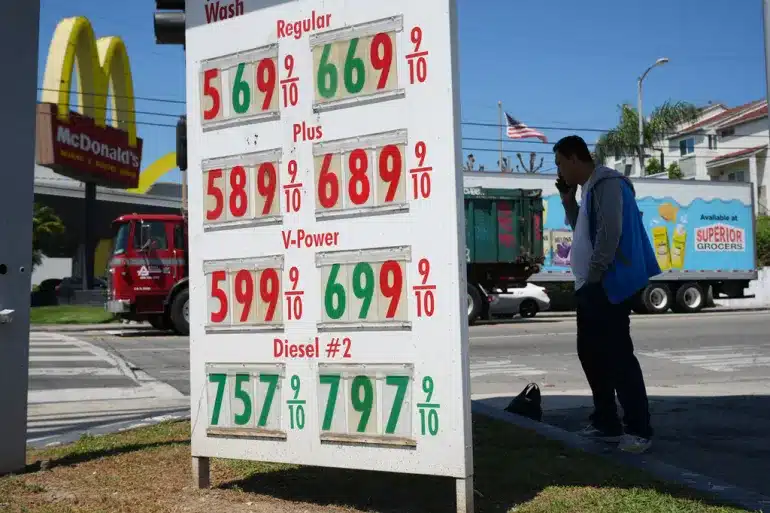
The latest US Inflation Surge is raising fresh concerns among policymakers and economists, as escalating conflict in the Middle East begins to ripple through global energy markets. With oil shipments disrupted and shipping lanes under threat, analysts warn that rising fuel costs could deepen economic uncertainty both in the United States and worldwide.
Recent data tied to US inflation 2026 trends suggests that energy-driven price pressures are once again becoming a major driver of inflation, reversing months of gradual cooling. At the center of this shift lies a growing geopolitical crisis involving Iran and the critical Strait of Hormuz.
What Happened
Tensions linked to the ongoing Iran war impact have triggered a Strait of Hormuz blockade, one of the world’s most crucial energy chokepoints. The narrow passage, through which nearly 20% of global oil supply flows, has seen shipping disruptions and rising security risks.
As a result, oil prices surge sharply in global markets. Brent crude and West Texas Intermediate benchmarks both climbed significantly in recent days, reflecting fears of prolonged supply shortages. This sudden spike has fueled a broader global oil supply crisis, sending shockwaves through energy-dependent economies.
In the United States, the consequences are already visible. Rising energy costs are pushing up transportation, manufacturing, and consumer goods prices, contributing directly to the renewed inflation spike.
Background of the Story
The Strait of Hormuz has long been a flashpoint in global geopolitics. Any disruption there has immediate consequences for the world oil trade impact. Historically, even minor tensions have led to volatility in oil prices.
This time, however, the stakes are higher.
The current Middle East tensions come amid an already fragile global economic environment. Supply chains have not fully recovered from earlier disruptions, and central banks are still grappling with inflation control measures introduced in recent years.


The oil market disruption triggered by the blockade is not just about supply. It also reflects broader uncertainty—investors are reacting to the risk of escalation, not just current shortages.
Reactions and Statements
US officials have acknowledged the seriousness of the situation. A senior Federal Reserve representative noted that “rising energy costs remain one of the most unpredictable inflation drivers,” adding that the central bank is closely monitoring developments.
Meanwhile, analysts at institutions like the International Energy Agency (IEA) have warned that even a temporary disruption could push fuel prices increase further, especially if alternative supply routes fail to compensate quickly.
According to reports from Reuters, market traders are pricing in the possibility of prolonged instability in the region. Some economists suggest that the geopolitical tensions economy link is becoming more evident again after a relatively stable period.
On the political front, US leaders have called for de-escalation, while also exploring strategic reserves to cushion domestic markets.
Global or Political Impact
The consequences extend far beyond the United States.
A sustained global oil supply crisis could trigger a wider global economic crisis, particularly in energy-importing nations. Countries in Europe and Asia, already dealing with slow growth, may face additional pressure as import bills rise.
For the US economy news outlook, the situation is equally complex. Higher fuel prices increase inflation while also reducing consumer spending power—a combination that could lead to an economic slowdown US scenario.
There’s also the risk of broader financial instability. Stock markets often react sharply to oil price volatility, and prolonged uncertainty could impact investment flows globally.
Experts warn that the world oil trade impact of a prolonged blockade could reshape energy alliances, forcing countries to rethink supply chains and strategic reserves.
Expert Analysis
Energy economists say the current situation highlights a recurring vulnerability in the global system.
“Whenever there is a disruption in the Strait of Hormuz, the effects are immediate and far-reaching,” said an analyst at the International Crisis Group. “What we’re seeing now is not just a price spike—it’s a structural shock.”
Data from the US Energy Information Administration shows that even a $10 increase in oil prices can significantly raise consumer inflation over time. With oil prices surge already exceeding that threshold in some markets, the inflationary pressure could persist.
Some experts also point out that inflation causes today are more complex than in the past. It’s no longer just about demand and supply—it’s about geopolitics, climate policies, and shifting global alliances.
Timeline of Events
- Early April 2026: Rising tensions between Iran and regional actors intensify
- Mid-April: Reports of shipping disruptions in the Strait of Hormuz emerge
- Shortly after: Oil prices surge across global markets
- Present: US inflation data reflects increasing pressure from energy costs
Related Developments
- Strategic petroleum reserves discussions gain momentum in Washington
- OPEC nations signal potential production adjustments
- Shipping insurance costs rise sharply in the Gulf region
- Airlines and logistics companies begin adjusting pricing models
What Happens Next
Much depends on how quickly the crisis de-escalates.
If shipping through the Strait of Hormuz resumes normally, markets could stabilize. However, prolonged disruption would likely sustain high energy prices, keeping inflation elevated.
The Federal Reserve may face a difficult balancing act—whether to maintain interest rate policies aimed at controlling inflation or adjust them to support slowing economic growth.
For consumers, the immediate concern is straightforward: higher fuel prices increase daily living costs, from commuting to groceries.
Why This News Matters
This isn’t just another fluctuation in oil markets. It’s a reminder of how interconnected the global economy has become.
The current global oil supply crisis underscores how a regional conflict can quickly evolve into a worldwide economic issue. From rising energy costs to broader inflation causes, the effects are being felt across industries and households.
For the United States, the US Inflation Surge signals that inflation risks are far from over. And for the world, it highlights the ongoing challenge of navigating economic stability in an era of persistent geopolitical uncertainty.
Key Takeaways
- The US Inflation Surge is being driven largely by rising energy costs
- The Strait of Hormuz blockade has disrupted global oil supply
- Oil prices surge is impacting fuel, transport, and consumer goods
- Middle East tensions are fueling broader economic concerns
- A prolonged crisis could lead to a global economic slowdown
Conclusion
As the situation unfolds, the link between geopolitics and economic stability is once again in sharp focus. The US Inflation Surge is not happening in isolation—it is deeply tied to the evolving crisis in the Middle East and its effect on global energy flows.
Whether this turns into a prolonged economic challenge or a short-term shock will depend largely on diplomatic developments in the coming weeks. For now, markets remain on edge, and policymakers face tough decisions in an increasingly uncertain world.
Source & Verification
This news topic is also reported by the international news organization Al Jazeera. US Inflation Surge Intensifies as Middle East Tensions Shake Global Oil Markets
Risk Reference:
https://www.aljazeera.com/news/2026/4/10/inflation-rises-in-us-amid-iran-war-hormuz-blockade